


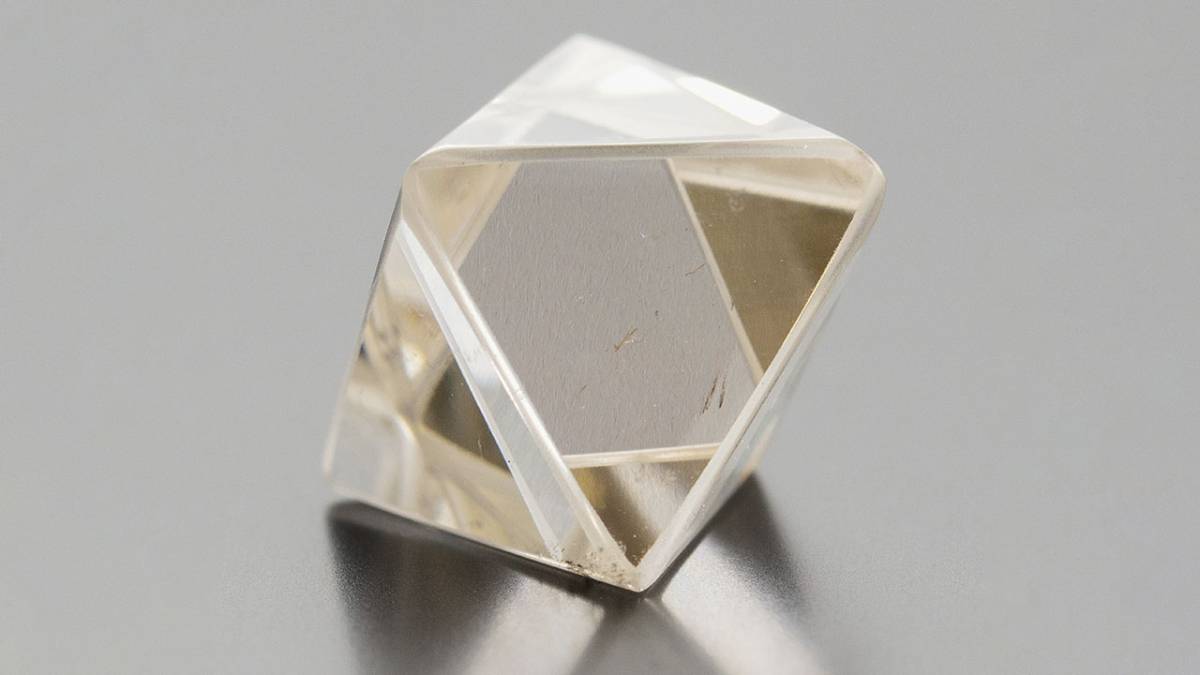

Researchers have identified a 6.87-carat CVD synthetic diamond fashioned to resemble a rough natural diamond crystal, in what they said was the first reported case of its kind.
The near-colourless stone, measuring approximately 11mm across, was examined by Nick Davies, Sema Firat, David Fisher and Thoufieq Shaik of De Beers Science & Technology. Their findings were published in the Spring 2026 edition of the Gemological Institute of America’s Gems & Gemology journal.
Surface Examination Reveals Differences
The stone had a near-octahedral outline similar to the crystal form of some natural rough diamonds. Examination showed that it was not a genuine octahedron, however, as only one set of opposite faces was parallel.
Microscopic analysis found flat faces marked by parallel polishing lines but none of the growth steps or triangular features, known as trigons, commonly seen on natural octahedral diamonds.
The facet junctions were also rough, possibly because of graphitisation during heat treatment intended to alter the stone’s colour. The principal faces appeared to have been repolished after treatment.
Crystal Orientation Confirms CVD Origin
X-ray diffraction showed that none of the stone’s faces was parallel to the {111} crystal planes found on a natural diamond octahedron. Two opposing faces were instead aligned with {100} planes, consistent with material cut from a block of CVD-grown diamond.
Fashioning the material into this form would require additional processing and result in a lower polished yield than cutting directly from the as-grown block. The authors said: “The only motivation for such an action appears to be a deliberate attempt at deceit.”
Infrared testing classified the stone as type IIa, meaning it contained no detectable nitrogen-related absorption. Although an estimated 1% to 2% of natural diamonds are type IIa, the researchers noted that well-formed natural octahedral diamonds are almost always type Ia. The combination of type IIa material and an octahedral appearance was therefore inconsistent with a natural origin.
Imaging Shows CVD Growth Features
DiamondView imaging confirmed that the stone was CVD-grown. It revealed orange luminescence bands associated with nitrogen-vacancy centres, with variations indicating interruptions or changes during the growth process.
Blue luminescence “plumes” associated with dislocation bundles were also visible. The researchers said these features were consistent with columnar growth previously reported in CVD synthetic diamonds.
Implications for Rough-Diamond Screening
The researchers said there was no evidence of widespread substitution of synthetic material for natural diamonds in the rough supply chain. However, the case shows that visual assessment and handling practices may not be sufficient when CVD material has been processed to imitate natural crystal morphology.
In particular, assessing a stone by its apparent “heft” would not provide reliable identification. In this case, examination of the surface characteristics, crystal orientation and luminescence patterns distinguished the stone from natural rough.
A range of existing diamond verification instruments referred the stone for further testing, while its characteristics matched those routinely observed in polished CVD diamonds. The authors said screening equipment used for polished stones could be adapted for rough diamonds if material fashioned in this way became more common.
For jewellers and other businesses buying rough diamonds, the case adds a further consideration to verification procedures, particularly where the origin of a stone has not been independently established.
