


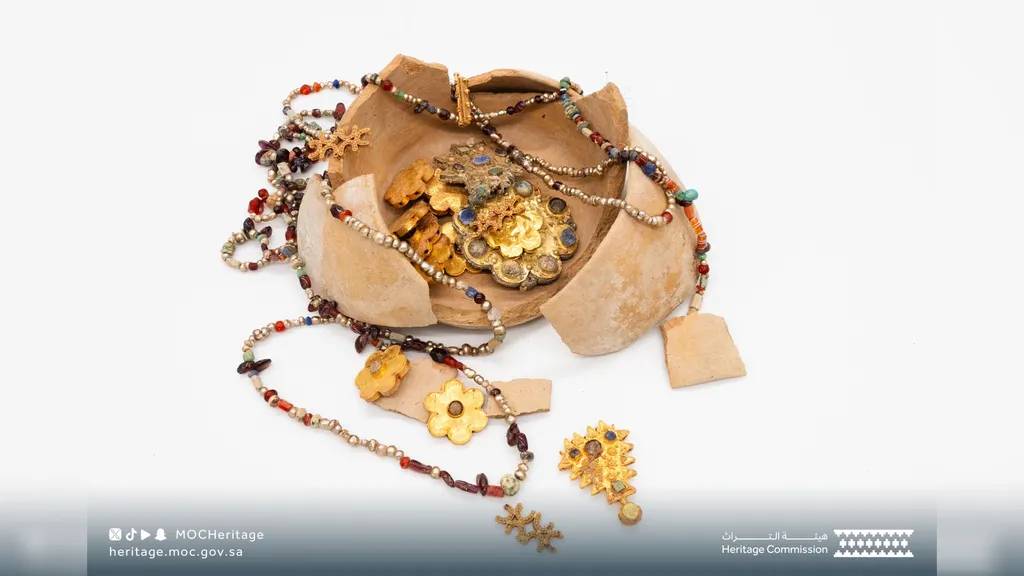

Archaeologists in Saudi Arabia have uncovered a hoard of gold jewellery, gemstones and other decorative objects dating back more than 1,100 years at the archaeological site of Dariyah in the Al-Qassim region.
The discovery, made during the latest excavation season led by the Saudi Heritage Commission, includes nearly 100 pieces of jewellery believed to date to the Abbasid period.
Dariyah was an important settlement on the historic route linking Basra in present-day Iraq with Mecca, serving travellers and pilgrims undertaking the Hajj during the early centuries of Islam.
Jewellery Found Inside Buried Ceramic Vessel
The collection, referred to by researchers as the “Dariyah Treasure”, was discovered inside a buried ceramic vessel during excavations of residential structures at the site.
Among the items recovered were gold pendants, beads, decorative fittings and other ornaments, alongside gemstones and oxidised copper fragments. Several pieces remain intact, with some retaining their original coloured stone settings.
The jewellery features floral and geometric motifs characteristic of the period. According to researchers, the pieces were produced using techniques including the shaping and embossing of thin gold sheets and the mounting of semi-precious stones.
One notable piece is a circular ornament decorated with stones arranged around a central feature.
Historic Settlement on Major Trade and Pilgrimage Route
Excavations have been ongoing at Dariyah for six years. Radiocarbon analysis of organic material suggests the main settlement was occupied during the mid-eighth century, around AD 743-753, coinciding with the early years of the Abbasid Caliphate.
In addition to the jewellery hoard, archaeologists uncovered gypsum water basins, stone foundations, mudbrick architecture, hearths and plastered rooms. Pottery fragments, glass and metal tools were also recovered.
The findings suggest Dariyah was a settled community that also served travellers moving along the route. Pilgrims, merchants and goods would have moved through the settlement on a regular basis.
Questions Remain Over Ownership
Researchers have not determined who owned the jewellery or why it was buried.
Possible explanations include ownership by a merchant, a wealthy local resident or a traveller passing through the settlement. Given Dariyah’s role as a key station on the Hajj route, archaeologists have also suggested a potential connection to pilgrims travelling to Mecca.
A laboratory expert with the Saudi Heritage Commission said: “One of the most important discoveries of this sixth season was the uncovering of the ‘Dariyah Treasure’, which consists of a collection of gold pieces, gemstones and oxidized copper fragments.”
Significance for Jewellery History
For the jewellery industry, the discovery provides additional insight into goldsmithing practices during the Abbasid era. The surviving decorative details and gemstone settings provide evidence of the manufacturing techniques used by jewellers in the region more than a millennium ago.
The find also provides evidence of how trade and pilgrimage routes contributed to the movement of precious materials, jewellery styles and manufacturing techniques across the Islamic world. Archaeologists plan to continue excavations at Dariyah, which may provide further information about jewellery production, trade and ownership during the period.
